
 Contact
 Hoe winkelen bij ons werkt
Bezorging
Winkelgids
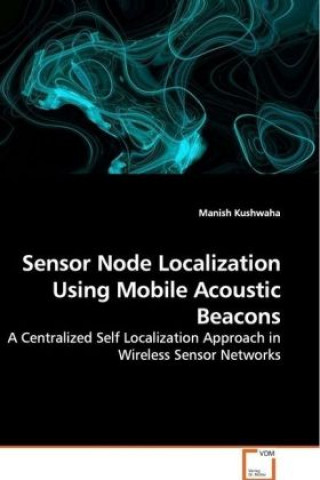
Sensor Node Localization Using Mobile Acoustic Beacons
A Centralized Self Localization Approach in Wireless Sensor Networks
 Engels
 127 b
127 b
Tot 30 dagen retourrecht
Klanten kochten ook





 /
/
 Gebonden (paperback)
 32.07
€
32.07
€





 /
Gebonden (paperback)
6.16
€
/
Gebonden (paperback)
6.16
€

 /
Gebonden (paperback)
10.31
€
/
Gebonden (paperback)
10.31
€



 /
Gebonden (paperback)
29.14
€
/
Gebonden (paperback)
29.14
€



In this monograph, we present a mobile acoustic §beacon based sensor node localization method. Our §technique is passive in that the sensor nodes §themselves do not need to generate an acoustic signal §for ranging. This saves cost, power and provides §stealthy operation. Furthermore, the beacon can §generate much more acoustic energy than a severely §resource constrained sensor node, thereby §significantly increasing the range. The acoustic §ranging method uses a linear frequency modulated §signal that can be accurately detected by matched §filtering. This provides longer range and higher §accuracy than the current state-of-the-art. The §localization algorithm was especially designed to §work in such acoustically reverberant environment, as§urban terrain. The algorithm presented handles non §Gaussian ranging errors caused by echoes. Node §locations are computed centrally by solving a global §non-linear optimization problem in an iterative and §incremental fashion. In this monograph, we present a mobile acoustic §beacon based sensor node localization method. Our §technique is passive in that the sensor nodes §themselves do not need to generate an acoustic signal §for ranging. This saves cost, power and provides §stealthy operation. Furthermore, the beacon can §generate much more acoustic energy than a severely §resource constrained sensor node, thereby §significantly increasing the range. The acoustic §ranging method uses a linear frequency modulated §signal that can be accurately detected by matched §filtering. This provides longer range and higher §accuracy than the current state-of-the-art. The §localization algorithm was especially designed to §work in such acoustically reverberant environment, as §urban terrain. The algorithm presented handles non §Gaussian ranging errors caused by echoes. Node §locations are computed centrally by solving a global §non-linear optimization problem in an iterative and §incremental fashion.


Informatie over het boek
Engels

Geef dit boek vandaag nog cadeau
Dat gaat heel eenvoudig
1 Voeg het boek toe aan je winkelwagentje en selecteer Als cadeau bezorgen 2 Je krijgt van ons per omgaand een voucher 3 Het boek wordt bezorgd op het adres van de ontvangerDit vind je misschien ook interessant


 /
/
 Audio cd
41.68
€
Audio cd
41.68
€



 /
Gebonden (paperback)
23.87
€
/
Gebonden (paperback)
23.87
€





 /
Gebonden (paperback)
22.96
€
/
Gebonden (paperback)
22.96
€
 /
Gebonden (paperback)
19.22
€
/
Gebonden (paperback)
19.22
€



 /
Gebonden (paperback)
188.22
€
/
Gebonden (paperback)
188.22
€



Hoi! Ik ben Libroamiko, je boekadviseur.
Hoe kan ik je helpen?