
 Contact
 Hoe winkelen bij ons werkt
Bezorging
Winkelgids
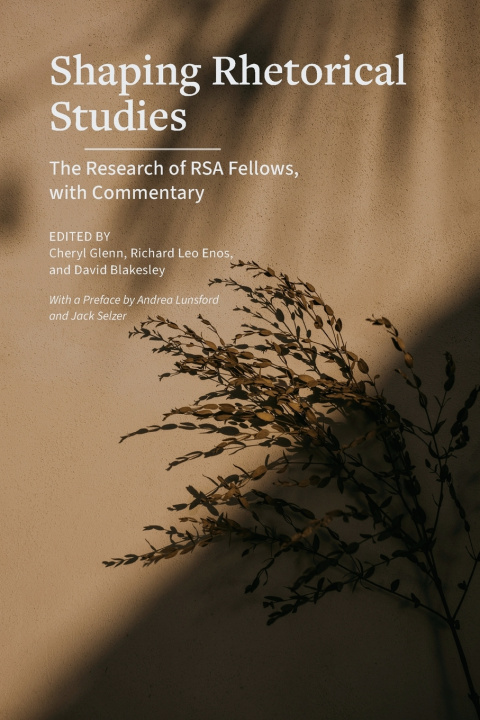
Shaping Rhetorical Studies
The Research of RSA Fellows, with Commentary
 Engels
 104 b
104 b
 Wordt verwacht
 Nieuw
Nieuw
Tot 30 dagen retourrecht

Edited by Cheryl Glenn, Richard Leo Enos, and David Blakesley
With a foreword by Andrea Lunsford and Jack Selzer
"These essays collectively emphasize 'the crucial importance of teaching and pedagogy, of collegiality and mentorship, and of risk-taking and intellectual courage.'" - Andrea Lunsford & Jack Selzer
Shaping Rhetorical Studies brings together landmark essays selected by Fellows of the Rhetoric Society of America as among the most important works of their scholarly careers. Representing more than five decades of rhetorical inquiry, the collection offers readers a rare opportunity to revisit foundational scholarship alongside new reflections from the scholars who produced it.
The volume traces the development of contemporary rhetorical studies across diverse areas of research, including rhetorical history, feminist historiography, composition theory, rhetorical agency, genre studies, public discourse, visual rhetoric, ethnography, science communication, pedagogy, film rhetoric, and digital humanities. Contributors engage rhetorical questions that continue to animate the field today: What are the boundaries of rhetoric? How do rhetorical practices shape public life? What counts as evidence or method in rhetorical research? How are agency, identity, listening, and civic participation rhetorically constituted?
The collection is organized into four thematic sections:
- Making Rhetorical History
- Developing Rhetorical Theory and Research
- Applying Rhetorical Studies
- Embodying and Enacting Rhetorical Studies
Each chapter pairs a landmark essay with new commentary in which contributors reflect on the intellectual contexts, collaborations, pedagogical concerns, and methodological risks that shaped their work. These retrospective essays provide readers with valuable insight into the development of rhetorical scholarship and the professional practices that sustain it.
In their foreword, Andrea Lunsford and Jack Selzer describe the collection as both "a retrospective of rhetorical studies" and "a group tutorial on how to be a consummate professional." Running throughout the volume are recurring themes of mentorship, teaching, intellectual courage, interdisciplinarity, and scholarly collaboration.
Featuring essays by Richard Leo Enos, Cheryl Glenn, Arthur Walzer, S. Michael Halloran, David Zarefsky, Victor J. Vitanza (with reflection by Cynthia Haynes), Edward Schiappa, Jeanne Fahnestock and Marie Secor, Cheryl Geisler, Jacqueline Jones Royster, Krista Ratcliffe, Gregory Clark, Gerard A. Hauser, Patricia Bizzell, Andrea Lunsford and Lisa Ede, Jack Selzer, Shirley Wilson Logan, David Blakesley, David Kaufer and Suguru Ishizaki, Carolyn R. Miller, Ralph Cintron, Lester Olson, Leah Ceccarelli, and Debra Hawhee, Shaping Rhetorical Studies serves as both an indispensable resource for specialists and an ideal introduction for graduate students and emerging scholars seeking to understand the evolution, scope, and future directions of rhetorical studies.
All proceeds from the sale of this book are donated by Parlor Press to the Rhetoric Society of America.


Informatie over het boek
Engels
Categorieën
