
 Contact
 Hoe winkelen bij ons werkt
Bezorging
Winkelgids
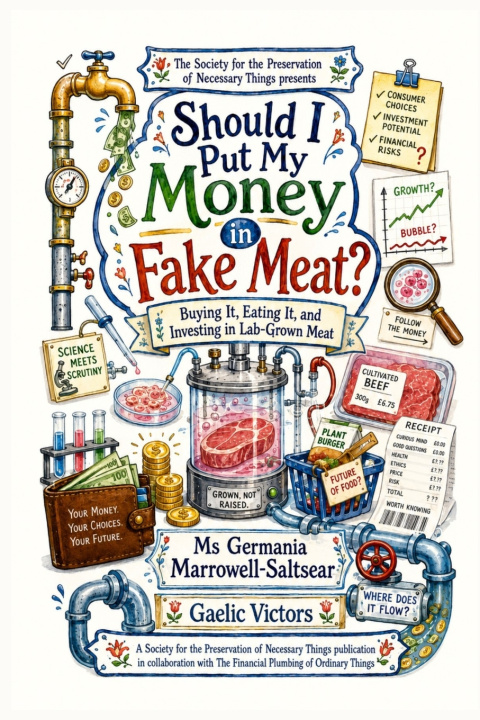
Should I Put My Money in Fake Meat?
What It Costs to Eat It. What It Costs to Own It.
 Engels
 44 b
44 b
 Nieuw
Nieuw
Tot 30 dagen retourrecht

The future of meat has acquired a bioreactor, a funding deck and an alarming confidence in its own inevitability.
Cultivated meat, also called cultured meat, cell-cultured meat and lab-grown meat, is presented as a possible answer to animal welfare, land use, emissions and food security. It is also a manufacturing business that must feed living cells, prevent contamination, operate equipment, satisfy regulators, persuade diners and eventually sell dinner at a price dinner is willing to pay.
Should I Put My Money in Fake Meat? examines both halves of the proposition: the food placed on the consumer's plate and the investment case placed before the wallet.
Ms Germania Marrowell-Saltsear follows the process from cell selection, cell banks and growth media to bioreactors, scaffolds, cultivated fat, hybrid products, factories, labels and the supermarket shelf. She separates scientific possibility from commercial repeatability, and a successful tasting from a company capable of producing consistent batches without consuming its balance sheet for lunch.
For consumers, the book investigates:
- What cultivated meat is, how animal cells become food and why the result is neither plant-based meat nor conventionally farmed meat
- How growth media, cell lines, bioreactors, scaffolding, fat, texture and food processing affect the final product
- What health, safety, animal-welfare and environmental claims can establish, and what remains dependent on energy, factory design, ingredients and scale
- Why taste, texture, price, labelling, trust, disgust and food-technology anxiety may matter as much as laboratory achievement
- Why cultivated fat, nuggets, meatballs, sausages and hybrid foods may reach the market before the magnificent steak displayed in the brochure
For investors, the book examines:
- Capital intensity, research costs, cash burn, funding rounds, dilution, manufacturing risk and the distance between technical milestones and profitable production
- The differences between public stocks, private cultivated meat companies, ingredient suppliers, equipment makers, licensing businesses and diversified food groups
- How to test market-size claims against obtainable revenue, production capacity, selling prices, gross margins and continuing demand for capital
- Why regulatory approval proves that a product may be sold, not that consumers will buy it often enough or that shareholders will be rewarded
- Four plausible futures: hybrid ingredients, premium niches, a broader food platform, or a laboratory archive purchased at a discount
This evidence-led guide is for readers interested in cultivated meat, lab-grown meat, cultured meat, cellular agriculture, alternative protein, future food, food biotechnology, sustainability claims and investment risk. It requires neither allegiance to the protein transition nor opposition to it.
It asks whether the product can become desirable food, whether the factory can become reliable infrastructure, whether the company can become profitable, and whether investors are being offered a business or front-row seating for a very expensive experiment.
This is not a prophecy dressed as a spreadsheet, nor a sermon wearing a lab coat.
Accept cultivated meat, reject it, invest in it or keep your wallet seated. First, the thing must explain itself.


Informatie over het boek
Engels

Geef dit boek vandaag nog cadeau
Dat gaat heel eenvoudig
1 Voeg het boek toe aan je winkelwagentje en selecteer Als cadeau bezorgen 2 Je krijgt van ons per omgaand een voucher 3 Het boek wordt bezorgd op het adres van de ontvangerHoi! Ik ben Libroamiko, je boekadviseur.
Hoe kan ik je helpen?