
 Contact
 Hoe winkelen bij ons werkt
Bezorging
Winkelgids
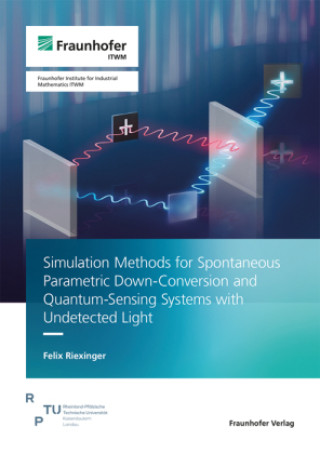
Simulation Methods for Spontaneous Parametric Down-Conversion and Quantum-Sensing Systems with Undetected Light
 Engels
 96 b
96 b
Tot 30 dagen retourrecht
Klanten kochten ook





 /
/
 Gebonden (paperback)
 14.45
€
14.45
€

Quantum sensing is a rapidly evolving field with the outlook of surpassing classical limitations. The field encompasses techniques such as noise-reduced imaging, super-resolution microscopy, as well as imaging and spectroscopy in challenging spectral ranges. Spontaneous parametric down-conversion sources are often employed for the generation of the correlated biphoton states required for these detection schemes.
In this work a general simulation method is demonstrated and used to reproduce the absolute counts of an experiment. Further, a gap exists between theoretical predictions for the performance of quantum-sensing systems and experimental results. This work bridges that gap with a simulation method for quantum-sensing with undetected light which includes experimental imperfections. For this, a theoretical approach is developed, and its capabilities are demonstrated with the simulation of aligned and misaligned quantum-imaging experiments. The results recreate the characteristics of the experimental data and are used to identify errors in experimental setups. The presented methods are broadly applicable and provide a step toward powerful simulation tools for quantum-sensing systems.


Informatie over het boek
Engels

Geef dit boek vandaag nog cadeau
Dat gaat heel eenvoudig
1 Voeg het boek toe aan je winkelwagentje en selecteer Als cadeau bezorgen 2 Je krijgt van ons per omgaand een voucher 3 Het boek wordt bezorgd op het adres van de ontvangerDit vind je misschien ook interessant
 /
Gebonden (paperback)
14.85
€
/
Gebonden (paperback)
14.85
€








 /
Gebonden (paperback)
25.87
€
/
Gebonden (paperback)
25.87
€





 /
Gebonden (paperback)
20.31
€
/
Gebonden (paperback)
20.31
€

Hoi! Ik ben Libroamiko, je boekadviseur.
Hoe kan ik je helpen?