
 Contact
 Hoe winkelen bij ons werkt

Bezorging
Winkelgids
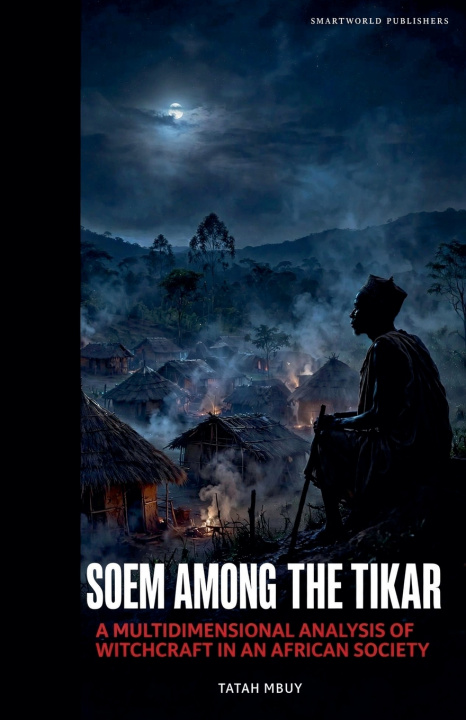
"Soem" among the Tikar
A Multidimensional Analysis of Witchcraft in an African Society
 Engels
 50 b
 Nieuw
Tot 30 dagen retourrecht

"SOEM" Among The Tikar presents a groundbreaking ethnographic and philosophical investigation into the institution of Soem within Tikar society of the Adamawa Plateau and the Mbam plain region of Cameroon. The book moves beyond simplistic translations of Soem as "witchcraft" and reframes it as a total social, spiritual, ontological, and jurisprudential system that structures Tikar reality.
Tatah Mbuy's central argument is that Soem cannot be understood through imported moral binaries of good versus evil. Instead, it is a morally ambivalent, highly potent vital force - a form of esoteric knowledge and spiritual capital - whose meaning is entirely dependent on its holder's social intention and its communal deployment. The book demonstrates how Soem serves simultaneously as a theory of power, an explanation for misfortune, a system of social control, a healing art, and a language for negotiating inequality.
The study is built on over 36 months of immersive fieldwork in Bankim, Ngambe-Tikar, Magba and surrounding chiefdoms, using oral histories, participation in palace societies, divination sessions, healing rituals, and life histories of recognized Soem-holders.
CHAPTER-BY-CHAPTER SYNTHESIS
1. The Tikar Cosmos: Personhood, Power, and the Invisible
Mbuy establishes the ontological foundation. For the Tikar, the world is divided into _nkwen_ (the visible world of everyday life) and _nsoem_ (the invisible, potentiated world that doubles and animates the visible). A complete human being is composed of _nyi_ (body), _shi_ (shadow/double), and _mgbati_ (breath-life force). Personhood is not achieved at birth but is progressively constructed through initiation, moral conduct, and the accumulation of _ndue_ (social weight).
Power, in Tikar thought, is never merely physical or economic. Legitimate authority must have a spiritual undergirding. The Fon (King), the _Nji_ (regulatory societies), and the elders do not simply rule; they _see_. The capacity to see beyond the ordinary is the ultimate form of authority. This introduces Soem as the epistemological key: Soem is the capacity to operate effectively in _nsoem_ to affect _nkwen_. Without understanding this, the outsider misreads everything.
2. Defining Soem: Beyond the Lexicon of Witchcraft
This chapter deconstructs the translation problem. Early external observers, operating with limited cosmological literacy and theological anxieties, collapsed the complex lexicon of Tikar esotericism into the single English term "witchcraft." Mbuy recovers the indigenous taxonomy:
- Soem ye Dwen (Soem of the Stomach/Womb): Considered the most potent and dangerous. Believed to reside as a living entity in the abdomen. It is often described as having eyes, teeth, and a will of its own. It can be inherited, bought, or inadvertently acquired. It grants powers of metamorphosis, night travel, and spiritual ingestion.
- Soem ye Mis (Soem of the Eyes): The power of the seers, diviners, and healers. It allows one to perceive hidden forces, diagnose the true cause of illness, and locate lost objects. It is generally viewed as socially positive, though its holders are feared for their penetrating gaze.
- Soem ye Nji (Soem of the Societies): The collective, institutionalized Soem held by regulatory societies like the _Nji Mgbang_ and _Nji Soem_. This is Soem tamed by tradition, used for community protection, oath-taking, and enforcement of communal law.
Mbuy argues that to call all three "witchcraft" is akin to calling a surgeon, a soldier, and a murderer all "knife-users" - technically true but analytically useless. The Tikar themselves make sharp moral distinctions not by the power itself, but by its _directionality_: Is it used to _build_ (Soem ye Nkun - constructive Soem) or to _devour_ (Soem ye Gba - devouring Soem)?


Informatie over het boek
Engels

Geef dit boek vandaag nog cadeau
Dat gaat heel eenvoudig
1 Voeg het boek toe aan je winkelwagentje en selecteer Als cadeau bezorgen 2 Je krijgt van ons per omgaand een voucher 3 Het boek wordt bezorgd op het adres van de ontvangerHoi! Ik ben Libroamiko, je boekadviseur.
Hoe kan ik je helpen?