
 Contact
 Hoe winkelen bij ons werkt
Bezorging
Winkelgids
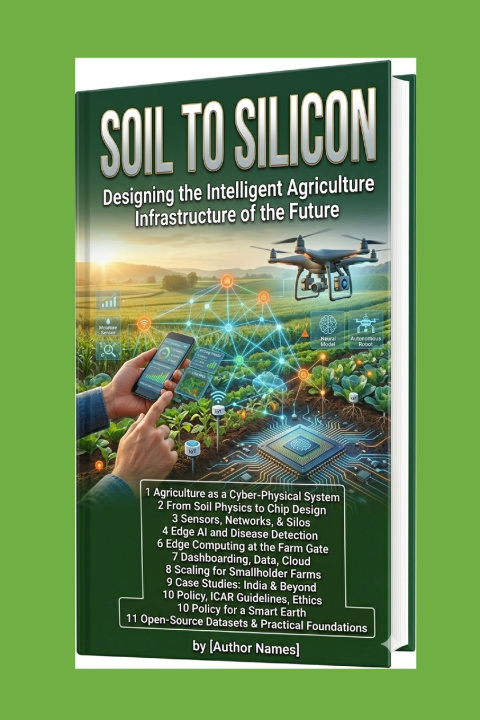
Soil to Silicon
Designing the Intelligent Agriculture Infrastructure of the Future : From Raw Soil Data to Autonomous Decisions
 Engels
 22 b
22 b
 Wordt verwacht
 Nieuw
Nieuw
Tot 30 dagen retourrecht

Complete Book Roadmap: Intelligent Agriculture Systems
This book follows a layered, system-engineering roadmap that mirrors how intelligent agriculture solutions are conceived, built, deployed, scaled, and governed in the real world. Each chapter adds one essential layer, progressing from foundational thinking to national-scale systems and hands-on implementation.
Part I - Foundations: Engineering Agriculture as a SystemChapter 1 - Agriculture at a Turning Point
Establishes agriculture as a complex socio-technical system under pressure from climate change, resource scarcity, and scale. Introduces the engineering mindset required for modern farming.
Chapter 2 - Agriculture as a Cyber-Physical System
Defines agriculture as a CPS with physical, digital, and control layers. Introduces feedback loops, edge vs. cloud architectures, and human-in-the-loop design.
Chapter 3 - Sensors, Soil, and Agricultural Data Pipelines
Builds the data foundation. Covers soil and environmental sensing, field constraints, data validation, and the transformation of raw signals into ML-ready datasets.
Part II - Intelligence: From Data to Decisions
Chapter 4 - AI Models for Agricultural Decision-Making
Introduces the intelligence layer. Covers problem framing, classical machine learning, time-series forecasting, and computer vision, all embedded within closed-loop agricultural CPS.
Chapter 5 - Edge AI and Computer Vision for Crop Disease Detection
Focuses on deploying AI under real-world constraints. Covers lightweight models, model optimization, edge inference, and smartphone-based disease detection.
Part III - Infrastructure and Deployment
Chapter 6 - IoT Deployment and Edge Computing for Intelligent Agriculture
Addresses field-scale deployment. Covers sensor placement, communication protocols, edge-cloud collaboration, reliability, security, and fault tolerance.
Chapter 7 - Dashboarding, Data Management, and Cloud Infrastructure
Explores orchestration at scale. Covers cloud architectures, data management, dashboards, interoperability, governance, and national-level deployment models.
Chapter 8 - Scaling Intelligent Agriculture Systems for Smallholder Farms
Focuses on inclusive design. Covers affordability, offline-first systems, rural connectivity, cooperative deployment models, and smallholder-focused case studies.
Chapter 9 - Case Studies: Intelligent Agriculture in India and Beyond
Demonstrates real-world implementations across regions. Analyzes architectures, deployment challenges, impact metrics, and transferable engineering patterns.
Part V - Governance, Policy, and Responsible Deployment
Chapter 10 - Policy, ICAR Guidelines, and Ethical Deployment
Situates intelligent agriculture within policy and ethical frameworks. Covers data ownership, explainable AI, governance in India, and global policy perspectives.
Part VI - Applied Implementation and Practice
Chapter 11 - Open-Source Datasets and Practical Foundations for Intelligent Agriculture Systems
Converts theory into practice. Provides open datasets, Python implementations, and end-to-end projects that integrate sensing, AI, edge deployment, and dashboards.
Capstone Perspective
By the end of the book, readers will be able to design, build, and deploy full-stack intelligent agriculture systems-from soil sensors to AI-driven decisions-while respecting the biological, technical, and social realities of farming.


Informatie over het boek
Engels

Geef dit boek vandaag nog cadeau
Dat gaat heel eenvoudig
1 Voeg het boek toe aan je winkelwagentje en selecteer Als cadeau bezorgen 2 Je krijgt van ons per omgaand een voucher 3 Het boek wordt bezorgd op het adres van de ontvangerHoi! Ik ben Libroamiko, je boekadviseur.
Hoe kan ik je helpen?