
 Contact
 Hoe winkelen bij ons werkt
Bezorging
Winkelgids
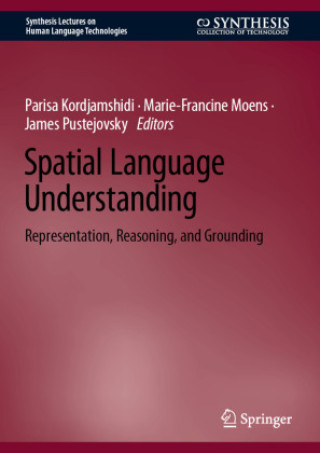
Spatial Language Understanding
Representation, Reasoning, and Grounding
 Engels
 98 b
98 b
Retourneren binnen 30 dagen
Klanten kochten ook





 /
/
 Gebonden (paperback)
 16.19
€
16.19
€












This book provides an overview of multiple aspects of spatial language understanding and explores recent trends of modeling based on very large foundational models and their applications. The authors address the following five main themes: spatial semantic representations in both symbolic and sub-symbolic spaces; spatial information extraction computational models; reasoning over spatial language; commonsense spatial understanding; and multiple modern and state-of-the-art downstream applications of spatial language understanding including dialogue systems, narrative discourse, and grounding language in the physical world with the multi-modal problem settings. One of the essential functions of natural language is to express spatial relationships between objects. Linguistic constructs can encode highly complex structures of objects, spatial relations between them, and patterns of motion through space relative to a reference point. The complexity of spatial language understanding and its importance in downstream tasks that involve grounding the language in the physical world has become evident and important to the natural language processing research community. In addition, this topic has recently attracted the attention of various sub-communities in the intersection of natural language, computer vision, and robotics.


Informatie over het boek
Engels

Geef dit boek vandaag nog cadeau
Dat gaat heel eenvoudig
1 Voeg het boek toe aan je winkelwagentje en selecteer Als cadeau bezorgen 2 Je krijgt van ons per omgaand een voucher 3 Het boek wordt bezorgd op het adres van de ontvangerDit vind je misschien ook interessant












 /
Gebonden (paperback)
69.25
€
/
Gebonden (paperback)
69.25
€










 /
Gebonden (paperback)
29.66
€
/
Gebonden (paperback)
29.66
€
Hoi! Ik ben Libroamiko, je boekadviseur.
Hoe kan ik je helpen?