
 Contact
 Hoe winkelen bij ons werkt
Bezorging
Winkelgids
 Engels
 121 b
121 b
Retourneren binnen 30 dagen
Klanten kochten ook








 /
/
 Gebonden (paperback)
 30.58
€
30.58
€

 /
Gebonden (paperback)
93.47
€
/
Gebonden (paperback)
93.47
€




















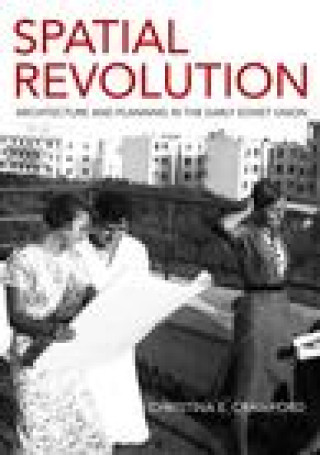
Spatial Revolution is the first comparative parallel study of Soviet architecture and planning to create a narrative arc across a vast geography. The narrative binds together three critical industrial-residential projects in Baku, Magnitogorsk, and Kharkiv, built during the first fifteen years of the Soviet project and followed attentively worldwide after the collapse of capitalist markets in 1929. Among the revelations provided by Christina E. Crawford is the degree to which outside experts participated in the construction of the Soviet industrial complex, while facing difficult topographies, near-impossible deadlines, and inchoate theories of socialist space-making. Crawford describes how early Soviet architecture and planning activities were kinetic and negotiated and how questions about the proper distribution of people and industry under socialism were posed and refined through the construction of brick and mortar, steel and concrete projects, living laboratories that tested alternative spatial models. As a result, Spatial Revolution answers important questions of how the first Soviet industrialization drive was a catalyst for construction of thousands of new enterprises on remote sites across the Eurasian continent, an effort that spread to far-flung sites in other socialist states—and capitalist welfare states—for decades to follow. Thanks to generous funding from Emory University and its participation in TOME (Toward an Open Monograph Ecosystem), the ebook editions of this book are available as Open Access volumes from Cornell Open (cornellpress.cornell.edu/cornell-open) and other repositories.


Informatie over het boek
Engels

Geef dit boek vandaag nog cadeau
Dat gaat heel eenvoudig
1 Voeg het boek toe aan je winkelwagentje en selecteer Als cadeau bezorgen 2 Je krijgt van ons per omgaand een voucher 3 Het boek wordt bezorgd op het adres van de ontvangerDit vind je misschien ook interessant





 /
Gebonden (paperback)
13.06
€
/
Gebonden (paperback)
13.06
€


 /
Gebonden (harde band)
209.34
€
/
Gebonden (harde band)
209.34
€




 /
Gebonden (harde band)
95.90
€
/
Gebonden (harde band)
95.90
€









Hoi! Ik ben Libroamiko, je boekadviseur.
Hoe kan ik je helpen?