
 Contact
 Hoe winkelen bij ons werkt
Bezorging
Winkelgids
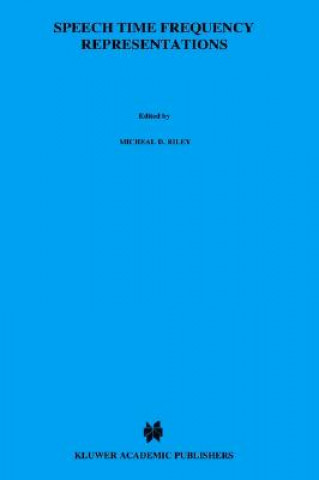
Speech Time-Frequency Representations
 Engels
 290 b
290 b
Retourneren binnen 30 dagen
Klanten kochten ook


 /
/
 Gebonden (paperback)
 10.02
€
10.02
€


 /
/
 Adobe ePub DRM
3.33
€
Adobe ePub DRM
3.33
€







1.1. Steps in the initial auditory processing. 4 2 THE TIME-FREQUENCY ENERGY REPRESENTATION 2.1. Short-time spectrum of a steady-state Iii. 9 2.2. Smoothed short-time spectra. 9 2.3. Short-time spectra of linear chirps. 13 2.4. Short-time spectra of /w /'s. 15 2.5. Wide band spectrograms of /w /'s. 16 Spectrograms of rapid formant motion. 2.6. 17 2.7. Wigner distribution and spectrogram. 21 2.8. Wigner distribution and spectrogram of cos wot. 23 2.9. Concentration ellipses for transform kernels. 28 2.10. Concentration ellipses for complementary kernels. 42 42 2.11. Directional transforms for a linear chirp. 47 2.12. Spectrograms of /wioi/ with different window sizes. 2.13. Wigner distribution of /wioi/. 49 2.14. Time-frequency autocorrelation function of /wioi/. 49 2.15. Gaussian transform of Iwioi/. 50 2.16. Directional transforms of lwioi/. 52 3 TIME-FREQUENCY FILTERING 3.1. Recovering the transfer function by filtering. 57 3.2. Estimating 'aliased' transfer function. 61 3.3. T-F autocorrelation function of an impulse train. 70 3.4. T-F autocorrelation function of LTI filter output. 70 Windowing recovers transfer function. 3.5. 72 3.6. Shearing the time-frequency autocorrelation function. 75 3.7. T-F autocorrelation function for FM filter. 76 3.8. T-F autocorrelation function of FM filter output. 77 3.9. Windowing recovers transfer function. 79 4 THE SCHEMATIC SPECTROGRAM Problems with pole-fitting approach.


Informatie over het boek
Engels
Categorieën

Geef dit boek vandaag nog cadeau
Dat gaat heel eenvoudig
1 Voeg het boek toe aan je winkelwagentje en selecteer Als cadeau bezorgen 2 Je krijgt van ons per omgaand een voucher 3 Het boek wordt bezorgd op het adres van de ontvangerDit vind je misschien ook interessant
 /
Gebonden (harde band)
184.22
€
/
Gebonden (harde band)
184.22
€





 /
Gebonden (paperback)
36.45
€
/
Gebonden (paperback)
36.45
€
 /
Gebonden (paperback)
103.10
€
/
Gebonden (paperback)
103.10
€


Hoi! Ik ben Libroamiko, je boekadviseur.
Hoe kan ik je helpen?