
 Contact
 Hoe winkelen bij ons werkt
Bezorging
Winkelgids
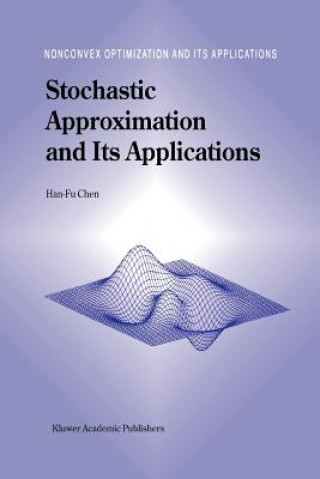
Stochastic Approximation and Its Application
 Engels
 249 b
249 b
Tot 30 dagen retourrecht
Klanten kochten ook















 /
/
 Paperback
 21.12
€
21.12
€








This book presents the recent development of stochastic approximation algorithms with expanding truncations based on the TS (trajectory-subsequence) method, a newly developed method for convergence analysis. This approach is so powerful that conditions used for guaranteeing convergence have been considerably weakened in comparison with those applied in the classical probability and ODE methods. The general convergence theorem is presented for sample paths and is proved in a purely deterministic way. The sample-path description of theorems is particularly convenient for applications. Convergence theory takes both observation noise and structural error of the regression function into consideration. Convergence rates, asymptotic normality and other asymptotic properties are presented as well. Applications of the developed theory to global optimization, blind channel identification, adaptive filtering, system parameter identification, adaptive stabilization and other problems arising from engineering fields are demonstrated.This book presents the recent development of stochastic approximation algorithms with expanding truncations based on the TS (trajectory-subsequence) method, a newly developed method for convergence analysis. This approach is so powerful that conditions used for guaranteeing convergence have been considerably weakened in comparison with those applied in the classical probability and ODE methods. The general convergence theorem is presented for sample paths and is proved in a purely deterministic way. The sample-path description of theorems is particularly convenient for applications. Convergence theory takes both observation noise and structural error of the regression function into consideration. Convergence rates, asymptotic normality and other asymptotic properties are presented as well. Applications of the developed theory to global optimization, blind channel identification, adaptive filtering, system parameter identification, adaptive stabilization and other problems arising from engineering fields are demonstrated.Audience: Researchers and students of both graduate and undergraduate levels in systems and control, optimization, signal processing, communication and statistics.


Informatie over het boek
Engels

Geef dit boek vandaag nog cadeau
Dat gaat heel eenvoudig
1 Voeg het boek toe aan je winkelwagentje en selecteer Als cadeau bezorgen 2 Je krijgt van ons per omgaand een voucher 3 Het boek wordt bezorgd op het adres van de ontvangerDit vind je misschien ook interessant
 /
Gebonden
29.56
€
/
Gebonden
29.56
€

 /
Paperback
14.07
€
/
Paperback
14.07
€

 /
Gebonden
22.92
€
/
Gebonden
22.92
€

 /
Paperback
18.60
€
/
Paperback
18.60
€














Hoi! Ik ben Libroamiko, je boekadviseur.
Hoe kan ik je helpen?