Contact
 Hoe winkelen bij ons werkt
Bezorging
Winkelgids
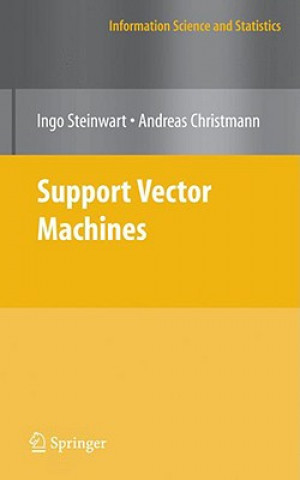
Support Vector Machines
 Engels
 560 b
560 b
Retourneren binnen 30 dagen
Klanten kochten ook




 /
/
 binding.
 134.90
€
134.90
€















 /
Gebonden (paperback)
42.74
€
/
Gebonden (paperback)
42.74
€





 /
Gebonden (paperback)
83.96
€
/
Gebonden (paperback)
83.96
€


This book explains the principles that make support vector machines (SVMs) a successful modelling and prediction tool for a variety of applications. The authors present the basic ideas of SVMs together with the latest developments and current research questions in a unified style. They identify three reasons for the success of SVMs: their ability to learn well with only a very small number of free parameters, their robustness against several types of model violations and outliers, and their computational efficiency compared to several other methods.The book provides a unique in-depth treatment of both fundamental and recent material on SVMs that so far has been scattered in the literature. The book can thus serve as both a basis for graduate courses and an introduction for statisticians, mathematicians, and computer scientists. It further provides a valuable reference for researchers working in the field. The book covers all important topics concerning support vector machines such as: loss functions and their role in the learning process; reproducing kernel Hilbert spaces and their properties; a thorough statistical analysis that uses both traditional uniform bounds and more advanced localized techniques based on Rademacher averages and Talagrand's inequality; a detailed treatment of classification and regression; a detailed robustness analysis; and a description of some of the most recent implementation techniques. To make the book self-contained, an extensive appendix is added which provides the reader with the necessary background from statistics, probability theory, functional analysis, convex analysis, and topology.


Informatie over het boek
Engels
Categorieën

Geef dit boek vandaag nog cadeau
Dat gaat heel eenvoudig
1 Voeg het boek toe aan je winkelwagentje en selecteer Als cadeau bezorgen 2 Je krijgt van ons per omgaand een voucher 3 Het boek wordt bezorgd op het adres van de ontvangerDit vind je misschien ook interessant

 /
Gebonden (harde band)
102.86
€
/
Gebonden (harde band)
102.86
€
 /
Gebonden (paperback)
12.12
€
/
Gebonden (paperback)
12.12
€



 /
Gebonden (paperback)
86.69
€
/
Gebonden (paperback)
86.69
€
 /
Gebonden (paperback)
21.21
€
/
Gebonden (paperback)
21.21
€

 /
Gebonden (harde band)
31.11
€
/
Gebonden (harde band)
31.11
€