
 Contact
 Hoe winkelen bij ons werkt
Bezorging
Winkelgids
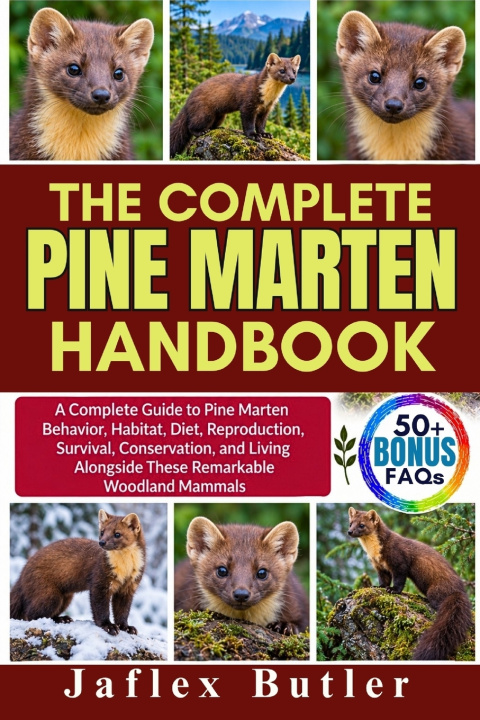
THE COMPLETE PINE MARTEN HANDBOOK
A Complete Guide to Pine Marten Behavior, Habitat, Diet, Reproduction, Survival, Conservation, and Living Alongside These Remarkable Woodland Mammals
 Engels
 54 b
54 b
 Wordt verwacht
 Nieuw
Nieuw
Tot 30 dagen retourrecht

Understanding the Pine Marten
The pine marten, Martes martes, is a slender, agile member of the mustelid family and one of the most characteristic woodland carnivores of Europe and parts of western Asia. It is closely associated with forests, but its ecology is broader than the name alone suggests. Pine martens can use mixed woodland, coniferous forest, rocky uplands, scrub, and some human-modified landscapes when these areas provide enough cover, food, and secure resting places. Their success depends heavily on their ability to move through complex environments both on the ground and above it.
Although pine martens are often described simply as small predators, they are better understood as highly adaptable omnivores with flexible behavior. They hunt small mammals and other animals, but they also eat fruits, berries, insects, carrion, and whatever seasonal foods are available. This dietary flexibility allows them to cope with substantial changes in weather and food supply throughout the year. Their long, supple bodies, strong limbs, curved claws, and excellent balance also make them particularly well suited to climbing and moving through wooded environments.
Pine martens are usually solitary and territorial, yet their lives are not entirely isolated. Individuals maintain home ranges that may overlap to varying degrees, especially between males and females, and they communicate extensively through scent marking. Much of their activity occurs during dusk, night, and early morning, although timing can change with season, food availability, disturbance, and local conditions. They are cautious animals, but they are also curious and capable of investigating unfamiliar objects or opportunities within their territory.
Understanding the pine marten requires looking beyond its appearance. Its survival is closely tied to habitat structure, seasonal food cycles, den availability, reproductive timing, and its remarkable ability to adjust behavior to changing landscapes. These features explain both its persistence in some regions and its vulnerability in others where woodland loss, persecution, or fragmentation has reduced suitable habitat.
Natural History, Origin, and Geographic Distribution
The pine marten belongs to the family Mustelidae, a diverse group that includes otters, weasels, polecats, badgers, and several other martens. Within this family, Martes martes is one of the best-known Eurasian marten species. Its evolutionary history reflects adaptation to temperate and boreal woodland environments where climbing ability, flexible feeding, and the use of concealed resting sites offered strong survival advantages.
The species is native across a broad portion of Europe and extends eastward into parts of western Asia. Its distribution includes areas of Scandinavia, central and eastern Europe, the British Isles, and parts of the Mediterranean and mountainous regions where suitable habitat persists. However, abundance is highly uneven. In some areas pine martens remain relatively widespread, while in others historical persecution and habitat loss caused severe local declines.
Woodland structure has played a major role in shaping this distribution. Pine martens generally benefit from forests that offer dense cover, tree cavities, fallen timber, rocky refuges, and connected travel routes. Mature woodland can provide especially valuable resting and denning opportunities, but pine martens are not restricted exclusively to ancient forest. They may also use younger woodland, plantation forests, forest edges, scrub, and mosaics of wooded and open habitats.
Their modern range also reflects human history. In parts of Europe, trapping, predator control, deforestation, and agricultural expansion greatly reduced populations.


Informatie over het boek
Engels
Categorieën

Geef dit boek vandaag nog cadeau
Dat gaat heel eenvoudig
1 Voeg het boek toe aan je winkelwagentje en selecteer Als cadeau bezorgen 2 Je krijgt van ons per omgaand een voucher 3 Het boek wordt bezorgd op het adres van de ontvangerHoi! Ik ben Libroamiko, je boekadviseur.
Hoe kan ik je helpen?