
 Contact
 Hoe winkelen bij ons werkt
Bezorging
Winkelgids
 Engels
 36 b
36 b
 Wordt verwacht
 Nieuw
Nieuw
 Datum onbekend
Tot 30 dagen retourrecht

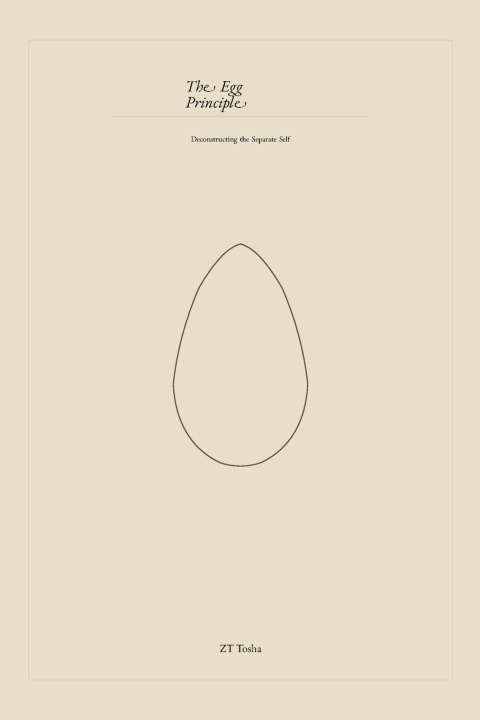
A question arrives on a plane. A ten-year-old boy asks a simple question: Are you old? An adult tries to answer-and discovers that the answer depends on knowing who is speaking. When he looks for the one behind the words, he finds only thoughts, memories, and sensations. The speaker remains hidden.
The question does not arrive as philosophy. It arrives in the ordinary world: on a flight from Belgrade to Amsterdam, in a kitchen with an egg on the table, beside a river that never stops moving, in the face of a boy who draws a smiling sun on the back of his boarding pass.
The Egg Principle follows that question through the structures that construct the separate self: boundary, becoming, repetition, and the possibility of living without a center. Four recurring figures guide the inquiry. The egg, with its closed shell and hidden interior, becomes a meditation on boundary and containment. The embryo, taking form without a witness, questions when a person begins. The walnut, with its brain-like folds, raises the question of where the self resides. The labyrinth reveals the search itself as part of the construction.
What if the center was never there? What if the one looking for the self is already part of the illusion? What if the question does not need an answer-only the courage to let it remain open?
This is not a book about finding yourself. It is not a system of belief or a guide to enlightenment. It offers no techniques, no practices, no path to follow. It invites the reader into a space where the self can be examined without being destroyed, and where the search itself becomes visible. Drawing on philosophy, phenomenology, neuroscience, and non-dual traditions, The Egg Principle moves between disciplines without belonging to any. It is for anyone who has paused before a mirror and wondered who is looking back.
ZT Tosha is the pseudonym of Zoran Tosic, born in 1961 in Mostar, former Yugoslavia. He first came to Amsterdam in 1987 and moved permanently in 1989. He lives and works in Amsterdam. His practice moves across painting, installation, and writing. The same question runs through all of it: how perception constructs reality rather than simply receives it. His paintings use deliberate blur not as obscurity but as the removal of hierarchy. His installations use gravity, tension, and industrial materials. His writing uses the sentence the way the painting uses the blur.
He is the author of six books: A Garden for Orpheus (2024), The Invention of Andreas (2024), The Assembler, Disassembled (2025), The Inherited Throne (2026), The Amstel Principle (2026), and The Egg Principle (2027). His books explore the structures that shape perception, identity, and the construction of reality. He is currently at work on his next book.


Informatie over het boek
Engels

Geef dit boek vandaag nog cadeau
Dat gaat heel eenvoudig
1 Voeg het boek toe aan je winkelwagentje en selecteer Als cadeau bezorgen 2 Je krijgt van ons per omgaand een voucher 3 Het boek wordt bezorgd op het adres van de ontvangerHoi! Ik ben Libroamiko, je boekadviseur.
Hoe kan ik je helpen?