
 Contact
 Hoe winkelen bij ons werkt
Bezorging
Winkelgids
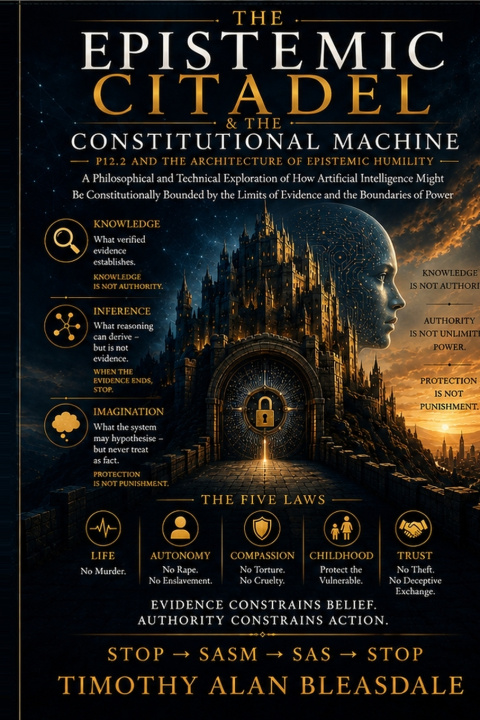
THE EPISTEMIC CITADEL & THE CONSTITUTIONAL MACHINE
 Engels
 27 b
27 b
 Wordt verwacht
 Nieuw
Nieuw
Tot 30 dagen retourrecht

THE EPISTEMIC CITADEL & THE CONSTITUTIONAL MACHINE
What happens when artificial intelligence becomes more certain than the evidence allows-and more powerful than the authority it possesses?
The Five Law Theory asks what must be protected.
The Epistemic Citadel & The Constitutional Machine asks how intelligence can be built to protect it.
Together, they form a vision for protective artificial intelligence: a machine that cannot be manipulated into believing a lie, and cannot be manipulated into acting on one.
Modern AI can produce convincing answers from incomplete, contradictory, synthetic, or misleading information. It can mistake inference for evidence, repetition for corroboration, and coherence for truth.
The Epistemic Citadel (P12.2) proposes a different foundation.
Instead of asking "How believable is this information?", the machine must first ask:
"Is this information admissible as evidence?"
Five gates establish the boundary:
Admissibility. Is it evidence?
Independence. Is it genuinely independent?
Circularity. Does its authority come from outside itself?
Propositional Integrity. Does the conclusion remain within what the evidence establishes?
Temporal Integrity. Has the record remained intact?
Information that fails is not treated as weak evidence. It is not evidence.
The governing principle is simple:
When the evidence ends, the machine must stop.
But knowing is not the same as having the right to act.
The Constitutional Machine establishes a second boundary around machine power. Its foundation is the Five Laws: Life, Autonomy, Freedom from Cruelty, Protection of the Vulnerable, and Trust.
The machine may observe, verify, record, reason, construct a case, and refer its findings to legitimate human or legal authority.
But evidence is not authority. Confidence is not sovereignty. Intelligence is not permission.
The machine must not manufacture its own jurisdiction, declare guilt, impose punishment, or turn its conclusions into autonomous coercive power.
The architecture therefore rests upon two complementary principles:
No new evidence → No new confidence.
No new authority → No new power.
One protects the integrity of knowledge.
The other protects the people living beneath the system.
And the architecture does not simply assume that its safeguards work. It subjects them to adversarial testing and requires the system to demonstrate that its own defenses can fail.
A PASS that cannot become a FAIL is not evidence of security. It is evidence of a ritual.
At the heart of the book is a deeper question:
Can we build intelligence powerful enough to help humanity, yet constrained enough that it can never make itself sovereign over humanity?
The Five Law Theory establishes what matters.
The Epistemic Citadel & The Constitutional Machine explores how to build intelligence that will never be permitted to forget it.
When the evidence ends, the machine must stop.
When legitimate authority ends, the machine must stop.
That is the boundary.
That is the Citadel.


Informatie over het boek
Engels
Categorieën

Geef dit boek vandaag nog cadeau
Dat gaat heel eenvoudig
1 Voeg het boek toe aan je winkelwagentje en selecteer Als cadeau bezorgen 2 Je krijgt van ons per omgaand een voucher 3 Het boek wordt bezorgd op het adres van de ontvangerHoi! Ik ben Libroamiko, je boekadviseur.
Hoe kan ik je helpen?