
 Contact
 Hoe winkelen bij ons werkt
Bezorging
Winkelgids
The Feedback Gap
Rethinking Assessment for Equity: The Ajibade Theory of Equitable Assessment
 Engels
 108 b
108 b
 Wordt verwacht
 Nieuw
Nieuw
Tot 30 dagen retourrecht

Feedback is one of the most powerful tools in education, and one of the most inconsistently delivered. For students from underrepresented, international, and first-generation backgrounds, well-intentioned feedback often fails to close the gap between comment and improvement, leaving students confused rather than clearer on what to do next.
The Feedback Gap argues that this failure is not a wording problem. It is a design problem, and an equity problem.
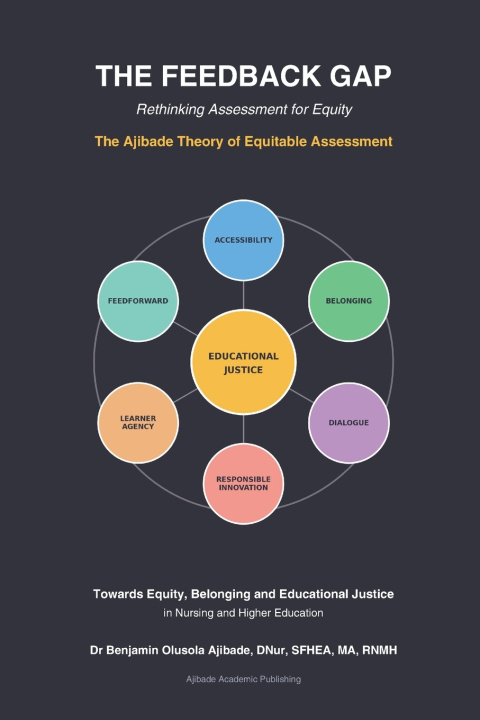
Drawing on the author's research into nursing students' lived experience of assessment feedback, this book introduces the Ajibade Theory of Equitable Assessment (ATEA), a middle-range theory built around six interdependent pillars: Accessibility, Assessment Belonging, Dialogue, Feedforward, Learner Agency, and Responsible Innovation, all oriented toward a single organising purpose: Educational Justice.
Rather than offering another checklist of marking tips, this book repositions assessment itself as one of the most powerful, and least examined, levers for advancing equity in higher education. Readers will find:
- The philosophical and theoretical foundations underpinning ATEA
- Practical application across curriculum design, practice learning, and institutional leadership
- Extension of the theory into digital and AI-supported assessment contexts
- Tools for auditing, redesigning, and evaluating feedback practice at module and programme level
- A complete architecture connecting theory, evidence, and institutional change
Written primarily from a nursing and healthcare education perspective, the principles offered here are relevant to any discipline committed to closing attainment gaps and building assessment systems that serve every learner, not just those who already know how to decode them.
For nurse educators, programme leaders, assessment designers, and anyone asking whether their feedback actually reaches the students who need it most.


Informatie over het boek
Engels

Geef dit boek vandaag nog cadeau
Dat gaat heel eenvoudig
1 Voeg het boek toe aan je winkelwagentje en selecteer Als cadeau bezorgen 2 Je krijgt van ons per omgaand een voucher 3 Het boek wordt bezorgd op het adres van de ontvangerHoi! Ik ben Libroamiko, je boekadviseur.
Hoe kan ik je helpen?