
 Contact
 Hoe winkelen bij ons werkt
Bezorging
Winkelgids
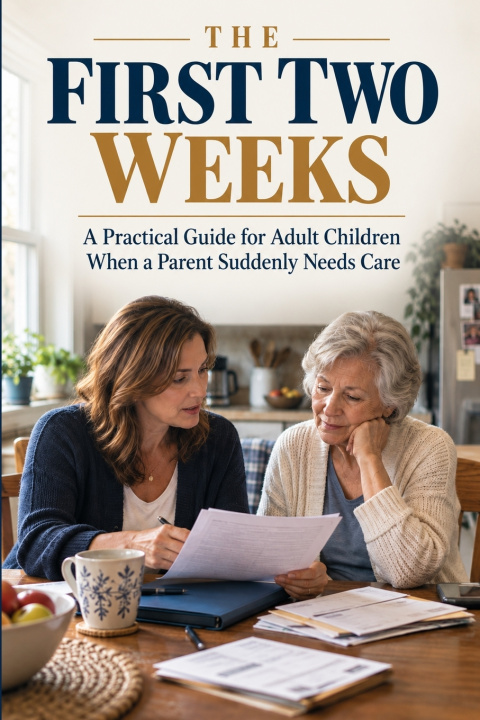
The First Two Weeks
A Practical Guide for Adult Children When a Parent Suddenly Needs Care
 Engels
 36 b
36 b
 Nieuw
Nieuw
Tot 30 dagen retourrecht

Nobody is ready for the phone call, and the reason is not emotional. It is administrative.
A parent falls. Or there is a stroke, a diagnosis, a surgery, or a discharge into a house that no longer suits them. Within about ninety minutes you are making decisions about a medical situation you do not understand, using information you do not have, for someone whose affairs you have never seen - while institutions with no obligation to talk to you politely decline to tell you things.
That is the actual experience of the first days. Not grief, at first. Logistics.
And the logistics are strange in a specific way: the situation is urgent, but almost none of the individual decisions are. Somebody has to decide tonight whether the dog gets fed. Nobody has to decide tonight whether your father will eventually need to move house. In the first days those two questions arrive in the same tone of voice, from the same people, and they are very hard to tell apart. Most of the damage families do to themselves comes from failing to tell them apart.
A deliberately narrow windowMost caregiving advice is written for the long term - how to plan, how to choose a facility, how to think about the years ahead. That is worth reading, eventually. It is close to useless at nine at night on the day your mother was admitted, when you have a job, a family, and forty unread messages.
This book covers roughly the first fourteen days. Not because two weeks solves anything, but because that is when the avoidable mistakes happen, and when a small amount of structure does the most good.
Four questions, asked repeatedly- What has actually changed? Separates fact from fear.
- What has to be true by tonight? Shrinks the horizon to something a tired person can manage.
- Who owns the next task? The one families skip, and why things fall through.
- What are we not deciding today? Permission to defer, so exhausted people stop making permanent decisions at the worst moment.
- What to do in the first 24 hours, and what to deliberately leave alone
- How to ask a care team narrow questions that get real answers
- The functional questions that decide whether home is workable
- What to ask before discharge, including the inpatient-versus-observation question that carries real financial consequences in the US
- How to check a discharge medication list against the bottles at home, where preventable harm most often happens
- How to make a house safe for the person coming back, not the person who left
- How to divide work between siblings without starting a war
- What to do when your parent says, "I don't need help"
- What long-distance children can genuinely do, and what requires presence
- Chapters on sibling conflict, money running out, and the point at which you are the one running on empty
- Twenty worksheets, checklists, and word-for-word scripts
- A thirty-day plan with a review date, so it is a plan rather than a hope
It does not assume you live nearby, that you have siblings, that they will help, that money is available, that your parent is cooperative, or that the two of you have an easy relationship. Plenty of people do this for a parent they find difficult, and that is its own kind of hard.
Sources are drawn from Medicare, the National Institute on Aging, the Social Security Administration, and the Administration for Community Living. Where a question becomes medical, legal, or financial, the book says so plainly and points you to the person qualified to answer it.
You do not need to solve the next year today. You need to understand what matters now, stabilize the situation, and make the next good decision.


Informatie over het boek
Engels

Geef dit boek vandaag nog cadeau
Dat gaat heel eenvoudig
1 Voeg het boek toe aan je winkelwagentje en selecteer Als cadeau bezorgen 2 Je krijgt van ons per omgaand een voucher 3 Het boek wordt bezorgd op het adres van de ontvangerHoi! Ik ben Libroamiko, je boekadviseur.
Hoe kan ik je helpen?