
 Contact
 Hoe winkelen bij ons werkt
Bezorging
Winkelgids
 Engels
 46 b
46 b
 Nieuw
Nieuw
Tot 30 dagen retourrecht

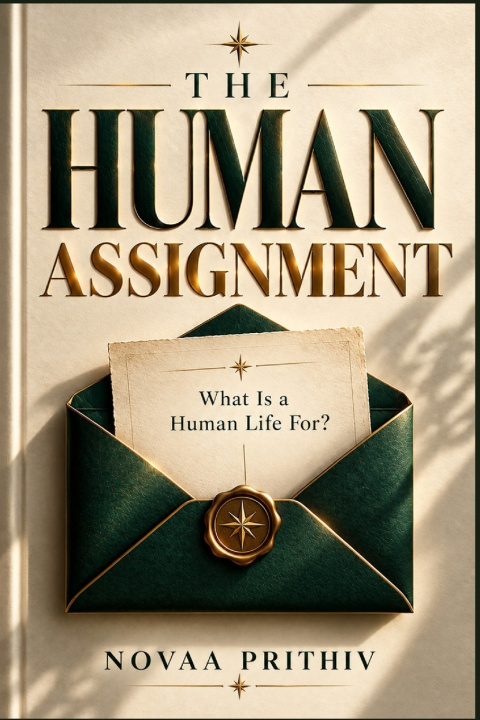
THE HUMAN ASSIGNMENT : What Is a Human Life For?
What is a human life for? The question seems simple until we examine the small word at its center: for. We ask it as though every human life must have a purpose waiting to be discovered, an instruction waiting to be understood, or an assignment waiting to be fulfilled. But what if that assumption has never actually been established?
Long before we can question the direction of our lives, we inherit answers. Grow. Learn. Work. Love. Succeed. Believe. Create. Leave something behind. Some become values we genuinely choose. Others remain within us because they arrived so early that we mistook inheritance for discovery.
Human beings have searched for purpose in family, culture, religion, philosophy, nature, evolution, work, achievement, love, knowledge, creation, legacy, and the universe itself. These can give us meaning, direction, and explanations. But none, by itself, establishes that human existence was given a universal assignment.
THE HUMAN ASSIGNMENT follows that question beneath the answers we have inherited. It examines how the self is formed, how culture and society shape what we believe a life should become, and how human beings construct stories, values, identities, and meanings to make existence intelligible.
At the center is a distinction that changes the entire question: meaning is not necessarily assignment. A person can find profound meaning in love without proving that love is the universal reason humanity exists. A person can choose a purpose without proving that the same purpose was written into reality for everyone. A life can have direction without having been directed.
The investigation then turns toward the sources we often assume can provide ultimate authority. Can nature tell us what we ought to become? Can evolution provide an instruction? Can the universe contain purpose without communicating one? And how do we distinguish what we believe, what we can know, and what remains unknown?
If no universal assignment has been established, does everything become meaningless? Not necessarily. Meaning, responsibility, love, creation, knowledge, commitment, and chosen purposes can remain real within the finite conditions of a human life. The absence of an externally guaranteed purpose may remove certainty, but it does not remove the need to decide what deserves our limited time, attention, and commitment.
THE HUMAN ASSIGNMENT does not offer a predetermined destiny or a formula for discovering the one purpose of every human life. It examines the assumptions beneath the answers we have inherited and follows them through meaning, identity, belief, achievement, freedom, responsibility, love, creation, and the finite reality of being alive.
By the end, the question has changed. We are no longer asking only what a human life is for. We are asking what, within the limited and unrepeatable reality of being alive, is actually worth giving a life to.
The question remains open. The life remains yours.


Informatie over het boek
Engels

Geef dit boek vandaag nog cadeau
Dat gaat heel eenvoudig
1 Voeg het boek toe aan je winkelwagentje en selecteer Als cadeau bezorgen 2 Je krijgt van ons per omgaand een voucher 3 Het boek wordt bezorgd op het adres van de ontvangerHoi! Ik ben Libroamiko, je boekadviseur.
Hoe kan ik je helpen?