
 Contact
 Hoe winkelen bij ons werkt
Bezorging
Winkelgids
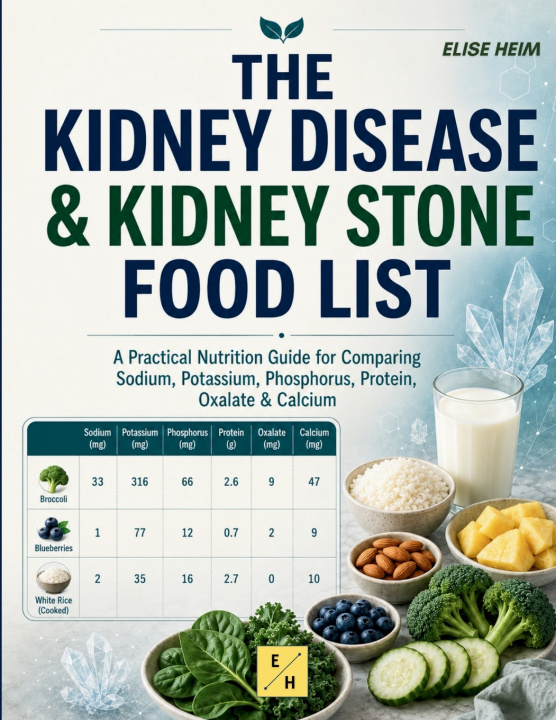
The Kidney Disease & Kidney Stone Food List
A Quick-Reference Guide to Sodium, Potassium, Phosphorus, Protein & Oxalate for CKD and Calcium Oxalate Stone Management
 Engels
 35 b
35 b
 Nieuw
Nieuw
Tot 30 dagen retourrecht

CLEARER FOOD DECISIONS FOR KIDNEY DISEASE, KIDNEY STONES - OR BOTH
Food choices can become confusing with chronic kidney disease, kidney stones, or both. A food may be low in sodium but high in potassium, rich in calcium but high in phosphorus, or have a very different oxalate profile.
The Kidney Disease & Kidney Stone Food List is designed for all three situations. If you have kidney disease, you can use the mineral, protein, and serving information even if you have never had a kidney stone. If you have kidney stones-particularly calcium oxalate stones-you can use the oxalate, calcium, sodium, and comparison sections even without CKD. If you are managing both, the six-value system brings the major considerations together in one place.
SIX IMPORTANT FOOD VALUES - ONE CLEAR SYSTEM
Every A-Z entry compares:
Sodium · Potassium · Phosphorus · Protein · Oxalate · Calcium
Each food includes a standardized 100 g reference plus a realistic household serving. Easy-to-scan LOW, MODERATE, HIGH, VERY HIGH, and GOOD SOURCE classifications make comparison faster.
EXTENSIVE A-Z FOOD REFERENCE
Look up fruits, vegetables, grains, beans, nuts, seeds, dairy foods, meat, seafood, snacks, drinks, and mixed foods. Entries identify preparation because raw, boiled, baked, canned, salted, unsalted, fortified, and processed foods can differ.
QUICK-REFERENCE TABLES FOR FASTER DECISIONS
Practical tools include
- Lowest-Oxalate Foods at a Glance
- Lower Potassium + Lower Oxalate Choices
- Lower Phosphorus + Lower Oxalate Choices
- Lower Potassium + Lower Phosphorus Choices
- Calcium-Rich Foods & Their Oxalate Profiles
- Smart Food Swaps
- Food Label Reading for Kidney & Stone Awareness
Calcium oxalate stones do not automatically mean dietary calcium should be minimized. The guide displays calcium and oxalate together and explains why appropriate dietary calcium with meals may help bind some oxalate in the digestive tract.
Not everyone with CKD needs the same potassium, phosphorus, or protein restrictions. Needs vary with kidney function, lab results, medications, dialysis status, and nutrition needs. The goal is to compare amounts and trade-offs-not label foods simply "good" or "bad."
SMART FOOD SWAPS & LABEL READING
Compare higher-oxalate foods with lower-oxalate alternatives, higher-potassium foods with lower-potassium options, and higher-sodium foods with lower-sodium alternatives.
The label-reading guide shows you how to check serving size, sodium, protein, calcium, potassium when listed, plus PHOS and potassium additives. Oxalate generally is not listed on standard labels.
RESEARCH-BASED DATA & TRANSPARENT METHODOLOGY
The tables draw primarily on USDA FoodData Central for sodium, potassium, phosphorus, protein, and calcium. The Oxalosis & Hyperoxaluria Foundation (OHF) database is the primary oxalate reference when a suitable match is available. The methodology explains standardization, servings, preparation differences, oxalate discrepancies, rounding, ranges, and N/A values.
USE THE PARTS THAT APPLY TO YOU
You do not need both kidney disease and kidney stones to benefit from this guide. Focus on the nutrients relevant to your needs-potassium and phosphorus for CKD, oxalate and calcium for calcium oxalate stones, or several values when both concerns overlap.
The Kidney Disease & Kidney Stone Food List helps you ask a more useful question than "Is this food kidney-friendly?"
What does this portion provide-and how does it fit the nutritional priorities that matter to me?
Whether shopping, planning meals, comparing foods, or reading labels, this guide helps you make everyday food decisions with greater confidence.


Informatie over het boek
Engels

Geef dit boek vandaag nog cadeau
Dat gaat heel eenvoudig
1 Voeg het boek toe aan je winkelwagentje en selecteer Als cadeau bezorgen 2 Je krijgt van ons per omgaand een voucher 3 Het boek wordt bezorgd op het adres van de ontvangerHoi! Ik ben Libroamiko, je boekadviseur.
Hoe kan ik je helpen?