
 Contact
 Hoe winkelen bij ons werkt
Bezorging
Winkelgids
 Engels
 373 b
373 b
Tot 30 dagen retourrecht
Klanten kochten ook























 /
/
 Gebonden (paperback)
 14.28
€
14.28
€


 /
Gebonden (paperback)
108.33
€
/
Gebonden (paperback)
108.33
€



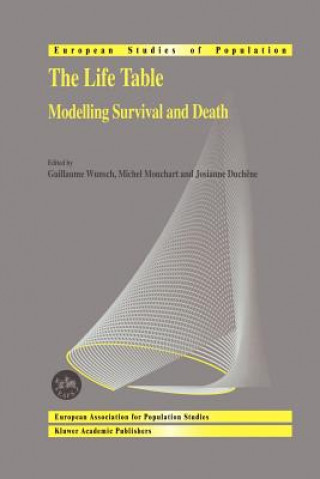
This work covers various important issues in life table construction and use. It. includes a non-technical overview, compares various methods of decomposing the difference in life expectancies, discusses the finding of suitable indicators and models, and deals with age, period, and cohort effects in mortality.The Life Table covers various important issues in life table construction and use. G. Wunsch presents a non-technical overview of the life table in the first chapter. G. Calot and A. Franco then give a detailed account of the estimation of the probability of dying between two consecutive ages, taking migration and the distribution of population at risk into account. E. Valkovics compares various methods of decomposing the difference in life expectancies. J. Anson deals with the problem of finding suitable indicators summarising the age distribution of mortality. Two chapters, respectively by G. Caselli and by E. Tabeau, F. Willekens, and F. van Poppel, are devoted to age, period, and cohort effects in mortality. Three chapters then deal more specifically with mortality by cause of death. F. Meslé first discusses the problem of adequately registering these causes. A.E. Kunst, J.P. Mackenbach, H. Lautenbach, F.B. Oei, and F. Bijlsma examine the gains in life expectancy obtained by eliminating major causes of death, taking into account competing causes of death. J. Duch


Informatie over het boek
Engels

Geef dit boek vandaag nog cadeau
Dat gaat heel eenvoudig
1 Voeg het boek toe aan je winkelwagentje en selecteer Als cadeau bezorgen 2 Je krijgt van ons per omgaand een voucher 3 Het boek wordt bezorgd op het adres van de ontvangerDit vind je misschien ook interessant




 /
Gebonden (paperback)
6.27
€
/
Gebonden (paperback)
6.27
€




 /
Gebonden (paperback)
17.83
€
/
Gebonden (paperback)
17.83
€






 /
Gebonden (paperback)
19.75
€
/
Gebonden (paperback)
19.75
€







Hoi! Ik ben Libroamiko, je boekadviseur.
Hoe kan ik je helpen?