
 Contact
 Hoe winkelen bij ons werkt
Bezorging
Winkelgids
 Engels
 70 b
70 b
 Nieuw
Nieuw
Tot 30 dagen retourrecht

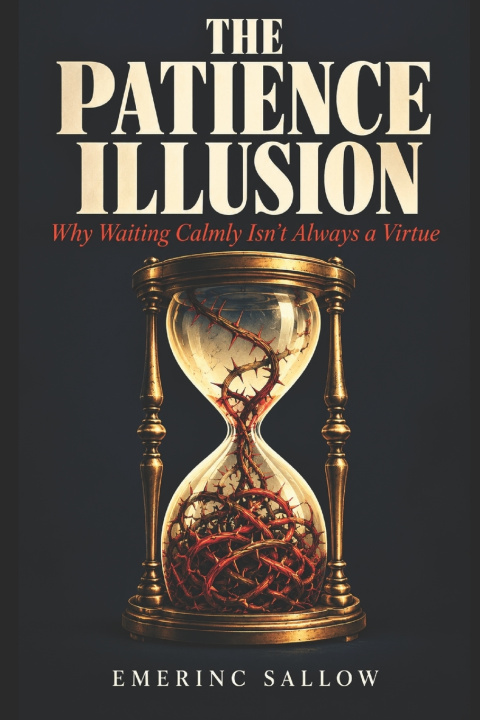
Marcus sat in the waiting room and told himself he was being patient. Three months later, that patience cost him the easiest version of his own treatment.
You have a Marcus story too. Almost everyone does. A conversation you have not had. An appointment you keep rescheduling. A raise you have not asked for, again, for the fourth year running. Somewhere along the way, you started calling the not-doing "patience," and it started to feel less like a delay and more like a virtue.
It usually is not.
The Patience Illusion makes a case that will change how you read your own stillness: a great deal of what we call patience is not a virtue being exercised. It is an exit being taken, quietly, from a moment that asked more of us than we wanted to give.
Drawing on decades of real, peer-reviewed research, from Martin Seligman's landmark work on learned helplessness to the actual data behind the famous marshmallow experiments (and the surprising, more human story behind their failed replication), from Steven Hayes's Acceptance and Commitment Therapy to the science of decision fatigue, this book hands you a simple, sharp tool: the Four Questions. Is there a strategy behind your waiting? Is there a condition that would end it? Is there a real, examined cost? And would you still call it patience if it failed?
Across thirteen chapters, The Patience Illusion walks directly into the five places this confusion costs the most: the career that waited one year too long, the marriage that mistook silence for peace, the medical appointment postponed until postponing became its own diagnosis, the financial decision left on autopilot, and, with the honesty a book like this owes its reader, the one domain where open-ended waiting is not an illusion at all: grief.
This is not another book telling you to hustle harder or want things more badly. It offers something more precise and more useful: a way to tell, in your own actual life, whether the waiting you are doing is a chosen strategy pointed at something real, or a comfortable habit your mind reaches for because acting felt harder in the moment.
You will meet a decade of glove cutters who kept believing "not yet" until they stopped. A marriage built quietly around one conversation nobody would risk having. A man whose recurring silence in every meeting felt, from the inside, exactly like wisdom. And you will leave with something more durable than motivation: a working test you can apply to your own life, starting today, before the next "later" quietly becomes another year.
If you have ever suspected that your own calm has an old fear buried inside it, this book will help you find out.
Written for readers of behavioral science, honest self-help, and anyone who has ever wondered, uncomfortably, whether they have been waiting for the right moment or simply avoiding the wrong feeling.


Informatie over het boek
Engels

Geef dit boek vandaag nog cadeau
Dat gaat heel eenvoudig
1 Voeg het boek toe aan je winkelwagentje en selecteer Als cadeau bezorgen 2 Je krijgt van ons per omgaand een voucher 3 Het boek wordt bezorgd op het adres van de ontvangerHoi! Ik ben Libroamiko, je boekadviseur.
Hoe kan ik je helpen?