
 Contact
 Hoe winkelen bij ons werkt
Bezorging
Winkelgids
 Engels
 49 b
49 b
 Wordt verwacht
 Nieuw
Nieuw
Tot 30 dagen retourrecht

Every day, you make decisions from incomplete clues. You sort a message before opening every detail. You decide whether a delay is ordinary or worrying. You hear several imperfect signals and form a view - then revise that view when new evidence appears.
That familiar human habit is the doorway to Naive Bayes, one of machine learning's most transparent classification methods.
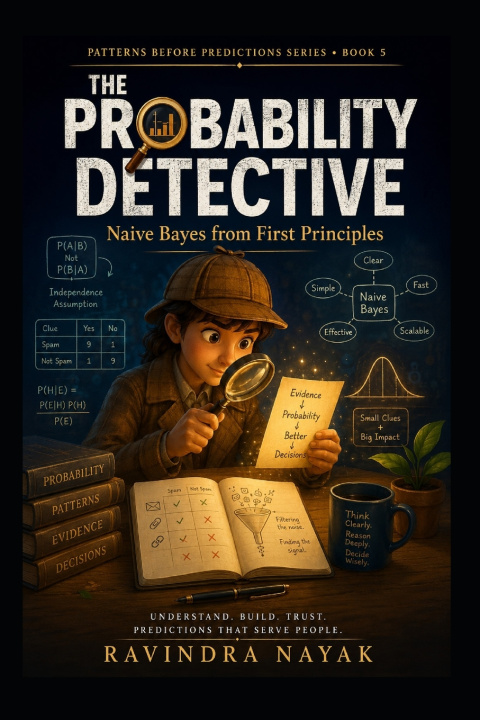
The Probability Detective: Naive Bayes from First Principles is a fear-free introduction for readers who may feel excluded by mathematics, programming, data science, or artificial intelligence. Instead of beginning with formulas, the book begins with a question: how can several weak clues become one useful conclusion?
Through the continuing story of a learning centre, natural dialogue, visual explanations, small arithmetic, hand-built tables, and practical case files, you will discover how a model learns from labelled examples and compares competing categories. Each mathematical idea arrives only after its purpose is clear.
You will learn how to understand:
• fractions, frequency, and probability without fear
• priors, base rates, likelihoods, and conditional probability
• how several clues combine inside a Naive Bayes classifier
• why smoothing prevents unseen clues from becoming impossible
• the differences among Bernoulli, Multinomial, and Gaussian Naive Bayes
• how training examples become probability tables and predictions
• confidence, calibration, thresholds, abstention, and human review
• where the method works well - and where correlated clues, bias, weak data, rare cases, and drift can mislead
• responsible applications in document routing, service support, education, healthcare administration, finance review, agriculture, and manufacturing
You will also build a small classifier by hand, investigate its mistakes, test whether its confidence deserves trust, and complete an active Value Edition filled with reconstruction maps, brain-training exercises, problem-solving frameworks, teach-back activities, a glossary, and practical field sheets.
This is not a promise of certainty, a shortcut to professional judgement, or a coding manual. It is a carefully layered journey into evidence, uncertainty, and responsible prediction.
By the final page, you will not merely recognise the words Naive Bayes. You will understand why the method exists, how it combines clues, what its mathematics means, when its answer may fail, and how to explain the complete reasoning to another person.


Informatie over het boek
Engels

Geef dit boek vandaag nog cadeau
Dat gaat heel eenvoudig
1 Voeg het boek toe aan je winkelwagentje en selecteer Als cadeau bezorgen 2 Je krijgt van ons per omgaand een voucher 3 Het boek wordt bezorgd op het adres van de ontvangerHoi! Ik ben Libroamiko, je boekadviseur.
Hoe kan ik je helpen?