
 Contact
 Hoe winkelen bij ons werkt
Bezorging
Winkelgids
Three-Body Problem
 Engels
 335 b
335 b
Retourneren binnen 30 dagen
Klanten kochten ook














 /
/
 Gebonden (paperback)
 18.93
€
18.93
€




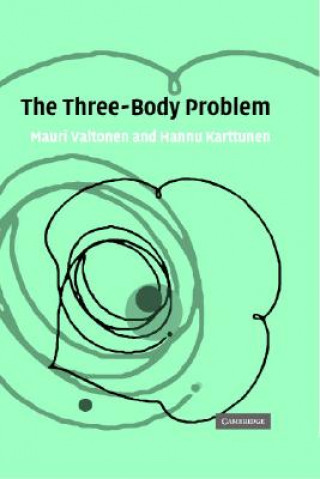
How do three celestial bodies move under their mutual gravitational attraction? This problem has been studied by Isaac Newton and leading mathematicians over the last two centuries. Poincaré's conclusion, that the problem represents an example of chaos in nature, opens the new possibility of using a statistical approach. For the first time this book presents these methods in a systematic way, surveying statistical as well as more traditional methods. The book begins by providing an introduction to celestial mechanics, including Lagrangian and Hamiltonian methods, and both the two and restricted three body problems. It then surveys statistical and perturbation methods for the solution of the general three body problem, providing solutions based on combining orbit calculations with semi-analytic methods for the first time. This book should be essential reading for students in this rapidly expanding field and is suitable for students of celestial mechanics at advanced undergraduate and graduate level.


Informatie over het boek
Engels

Geef dit boek vandaag nog cadeau
Dat gaat heel eenvoudig
1 Voeg het boek toe aan je winkelwagentje en selecteer Als cadeau bezorgen 2 Je krijgt van ons per omgaand een voucher 3 Het boek wordt bezorgd op het adres van de ontvangerDit vind je misschien ook interessant












 /
Gebonden (paperback)
17.51
€
/
Gebonden (paperback)
17.51
€




 /
Gebonden (paperback)
21.56
€
/
Gebonden (paperback)
21.56
€

Hoi! Ik ben Libroamiko, je boekadviseur.
Hoe kan ik je helpen?