
 Contact
 Hoe winkelen bij ons werkt
Bezorging
Winkelgids
 Engels
 36 b
36 b
 Nieuw
Nieuw
Tot 30 dagen retourrecht

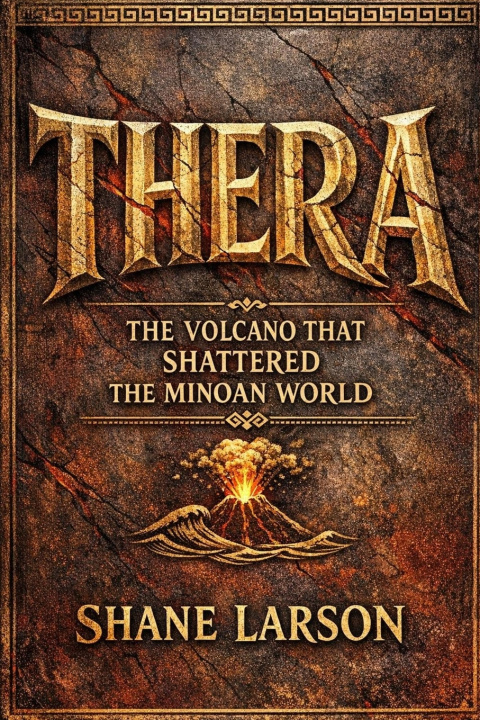
The largest eruption in four thousand years. And the city where nobody died.
Sometime in the middle of the second millennium BC, an island in the southern Aegean tore itself apart. Thera threw roughly sixty cubic kilometres of rock and ash into the sky, dropped the centre of itself into the sea, and left an ash layer that geologists still find in the Nile Delta and the Black Sea. It was larger than Krakatoa. It was larger than anything human beings have witnessed since.
Ninety miles to the south stood Knossos - the palace heart of the most sophisticated civilization Europe had yet produced. Within a few generations, the Minoans were finished as an independent power.
That is the story everyone half-knows. This book is about what the evidence actually supports - and what it refuses to settle.
Pompeii, but emptyBeneath metres of pumice on Thera lies Akrotiri: a Bronze Age town preserved the way Pompeii was preserved. Houses two and three storeys tall. Drainage beneath the streets. Painted walls showing fleets, monkeys, and boys boxing. It is the richest snapshot of ordinary Bronze Age life outside Egypt.
And unlike Pompeii, it is empty. No bodies. No valuables abandoned in panic. Furniture moved before the ash fell, and repair work from the warning earthquakes stopped mid-job. The people of Akrotiri saw it coming and they left - and no one knows where they went, or whether they survived.
Archaeology's hundred-year argumentThe most contested number in Bronze Age archaeology is the year Thera erupted. Radiocarbon, ice cores, and an olive branch buried alive in the pumice push it into the late 1600s BC. Egyptian chronology and the pottery sequence pull it a century later. A hundred years sounds like a technicality until you realise the entire question of what the volcano did to the Minoans hangs on it.
This book takes you inside that argument - tree rings, sulphate spikes, tephra chemistry, an ice-core signal that had to be reassigned - and shows how a date becomes a historical claim.
What a volcano can and cannot killThe Cretan palaces did not fall for another century. Crete was never buried in ash. The simple catastrophe story is wrong - and the true one is more interesting. Thera did not destroy the Minoans. It removed the margin that would have let them survive what came next.
And then, late and handled honestly: an advanced island civilization, wealthy and seafaring, swallowed by the sea in a single day and night. Was Thera the memory behind Plato's Atlantis? The answer is neither credulous nor contemptuous, and it is better than a yes or a no.
Inside this book- An hour-by-hour reconstruction of the eruption, built strictly from the deposits
- Akrotiri - the excavation, the frescoes, and the evacuation nobody can explain
- The tsunami evidence on Crete and what a wave does to a maritime economy
- Ash, sulphur, and the volcanic-winter question the proxies can and cannot answer
- The high-versus-low chronology dispute, made readable
- The Mycenaean takeover of Crete and the Linear B tablets that record it
- Atlantis, treated as historiography rather than a tease
- Three appendices: the dating dossier, a guide to the frescoes, and a volcanic scale for non-volcanologists
From the author of The Minoans, Sea Peoples, and Ancient Apocalypse: The Fall of the Bronze Age.
Scroll up and grab your copy today.


Informatie over het boek
Engels

Geef dit boek vandaag nog cadeau
Dat gaat heel eenvoudig
1 Voeg het boek toe aan je winkelwagentje en selecteer Als cadeau bezorgen 2 Je krijgt van ons per omgaand een voucher 3 Het boek wordt bezorgd op het adres van de ontvangerHoi! Ik ben Libroamiko, je boekadviseur.
Hoe kan ik je helpen?