
 Contact
 Hoe winkelen bij ons werkt
Bezorging
Winkelgids
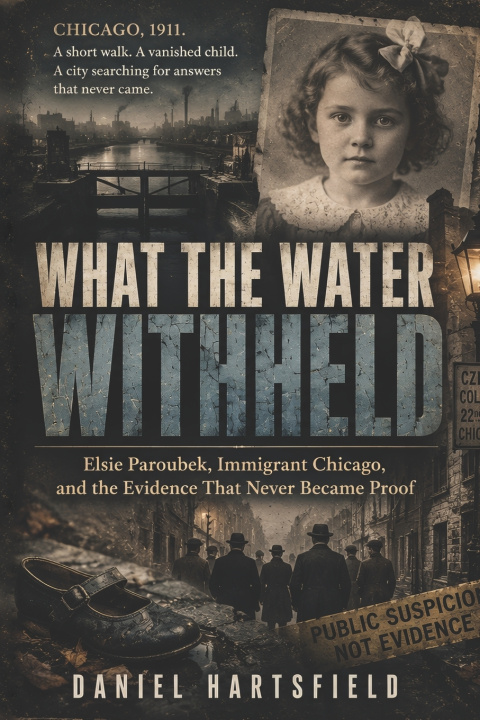
What the Water Withheld
Elsie Paroubek, Immigrant Chicago, and the Evidence That Never Became Proof
 Engels
 36 b
36 b
 Nieuw
Nieuw
Tot 30 dagen retourrecht

A child vanished in immigrant Chicago. A month later, the canal returned evidence-but not certainty.
On April 8, 1911, Eliška "Elsie" Paroubek disappeared from a familiar Chicago neighborhood while expected at a nearby relative's home. Roughly a month later, a child's body identified as Elsie was recovered from the Chicago Sanitary and Ship Canal near Lockport. The discovery ended the search for a missing child, but it did not answer the questions that followed.
What the Water Withheld is a historical true crime narrative about the Paroubek case, the Czech American community that searched for Elsie, and the fragile line between suspicion and proof. It follows the family's loss through neighborhood searches, police activity, newspaper coverage, public appeals, rewards, reported sightings, anonymous letters, and the expanding theories that drew strangers and entire ethnic groups into suspicion.
At the center of the case is a fractured evidentiary record. Contemporary and later accounts disagreed about Elsie's age, the timing and route of her disappearance, the date and circumstances of the recovery, and even the medical findings surrounding her death. Reports variously described drowning, no water in the lungs, suffocation, strangulation, suspected homicide, and an unknown cause. Without a complete original forensic record capable of resolving those conflicts, this book refuses to turn one version into certainty simply because it makes a cleaner story.
The investigation also reveals the pressures of early twentieth-century immigrant Chicago. Czech family networks, neighborhood life, street performers, police assumptions, newspaper language, and prejudice all shaped the search. Romani travelers, Italian street performers, local men, and others entered public suspicion, often without evidence strong enough to establish responsibility. No person was charged, tried, or convicted in connection with Elsie's death.
Rather than naming a culprit, the book asks a harder question: what can the surviving record actually bear? It separates confirmed facts from reported claims, allegations, interpretation, and speculation; tests the stories that accumulated around the case; and keeps contradictions visible when the evidence cannot responsibly settle them.
Written as restrained narrative nonfiction, the book combines historical investigation with an evidence-aware true crime approach. A timeline of events, key people glossary, and source index provide additional context for readers who want to follow the chronology, the competing accounts, and the limits of what survives.
For readers drawn to unresolved historical cases, immigrant Chicago history, missing-child investigations, and nonfiction that values evidence over easy answers, What the Water Withheld returns Elsie's name to the center of the story-and leaves the unanswered parts unanswered.


Informatie over het boek
Engels
Categorieën

Geef dit boek vandaag nog cadeau
Dat gaat heel eenvoudig
1 Voeg het boek toe aan je winkelwagentje en selecteer Als cadeau bezorgen 2 Je krijgt van ons per omgaand een voucher 3 Het boek wordt bezorgd op het adres van de ontvangerHoi! Ik ben Libroamiko, je boekadviseur.
Hoe kan ik je helpen?